At the Berlin-Dahlem-FU weather station, which we use for Berlin, the warmest month is July (average high 24.8 °C) and the coldest January (average low −1.6 °C), averaged over 1991–2020. The wettest month is July (77 mm of rain). Germany's quietest month for visitors in 2025 was January.
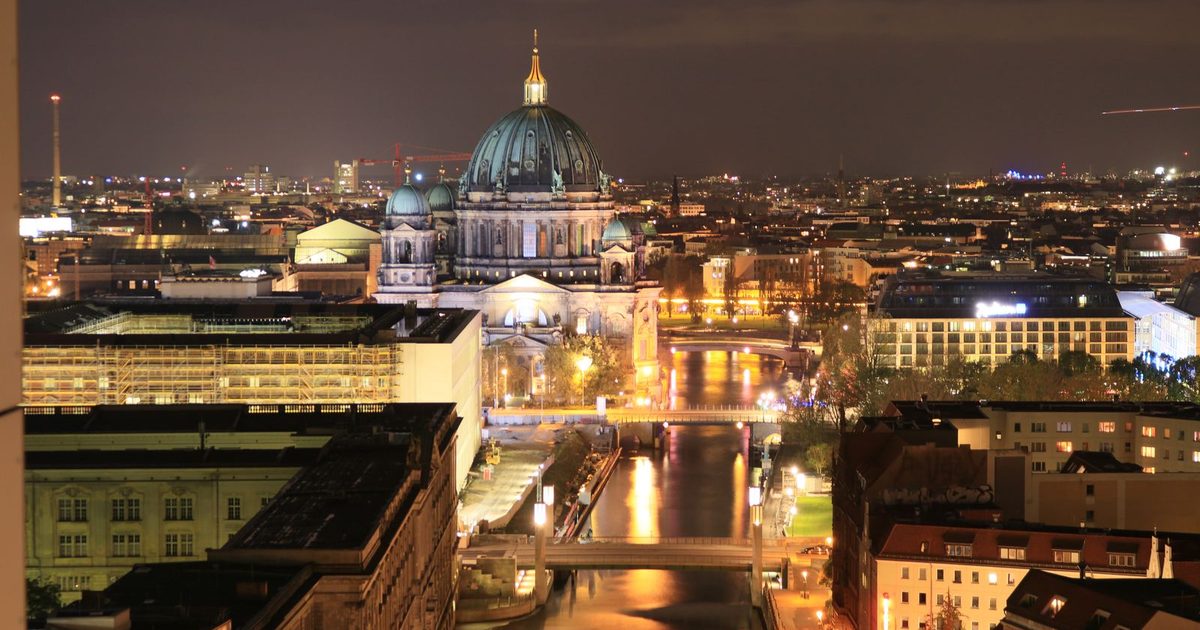
Berlin weather by month
Averages for 1991–2020 at the Berlin-Dahlem-FU weather station, copied from our Germany page, next to each month's share of Germany's tourist nights (Eurostat, 2025). These are long-term averages, not a forecast.
| Month | Average high | Average low | Rain | Rainy days | Daylight on the 15th | Share of 2025 |
|---|---|---|---|---|---|---|
| January | 3.4 °C | −1.6 °C | 47 mm | 16.3 days | 8 h 15 min | 4.8% |
| February | 5.1 °C | −1.1 °C | 36 mm | 13.9 days | 9 h 55 min | 5.1% |
| March | 9.1 °C | 1.0 °C | 41 mm | 14.3 days | 11 h 50 min | 6.3% |
| April | 15.4 °C | 4.6 °C | 29 mm | 11.0 days | 13 h 55 min | 8.2% |
| May | 19.7 °C | 8.6 °C | 54 mm | 13.0 days | 15 h 45 min | 9.6% |
| June | 22.8 °C | 11.8 °C | 59 mm | 12.9 days | 16 h 50 min | 10.3% |
| July | 24.8 °C | 14.1 °C | 77 mm | 13.6 days | 16 h 20 min | 11.7% |
| August | 24.6 °C | 13.6 °C | 62 mm | 12.8 days | 14 h 45 min | 12.4% |
| September | 19.7 °C | 9.9 °C | 46 mm | 11.6 days | 12 h 40 min | 9.9% |
| October | 13.9 °C | 5.8 °C | 45 mm | 14.4 days | 10 h 40 min | 9.2% |
| November | 7.8 °C | 2.3 °C | 42 mm | 15.0 days | 8 h 45 min | 6.2% |
| December | 4.2 °C | −0.4 °C | 46 mm | 16.7 days | 7 h 40 min | 6.3% |
Golden hour
Evening golden hour is our calculation for the 15th of each month of 2026: the time the sun takes to go from 6° above to 4° below the horizon (there is no official definition).
The quietest and busiest months
In 2025, January was Germany's quietest month (4.8% of the year's tourist nights): average high 3.4 °C, average low −1.6 °C, 47 mm of rain. August was the busiest (12.4%): average high 24.6 °C, average low 13.6 °C, 62 mm of rain. The figures do not show that the weather makes a month busier or quieter, so we do not say it does.
What these figures are
One weather station stands for Berlin; places nearby can differ, especially by height or distance from the sea. For the full picture of Germany, including regions and holidays, see our Germany page; for other places, the visual guides and golden hour by place.
Key takeaways
- Warmest month: July (average high 24.8 °C); coldest: January (average low −1.6 °C).
- Wettest month: July (77 mm); driest: April (29 mm).
- In 2025, January was Germany's quietest month for visitors and August the busiest.
Sources
Weather normals and daylight copied from our country or prefecture page; tourism shares from the same page. See how we research.
- Weather: WMO Member Nations (2023). WMO Climatological Standard Normals for 1991-2020 (NCEI Accession 0253808), station Berlin-Dahlem-FU (station ID 00010381), mean daily maximum and minimum temperature, precipitation and number of days with at least 1 mm of precipitation, and total hours of sunshine, normals computed from at least 24 years. NOAA National Centers for Environmental Information. Dataset. doi:10.25921/800j-vn07. Accessed 22 September 2026. Released by NOAA under CC0.
- Daylight: our calculation of the time from sunrise to sunset on the 15th of each month of 2026 at the weather station's location, by the method of the NOAA Solar Calculator (NOAA Global Monitoring Laboratory, “Solar Calculation Details”, based on Jean Meeus, Astronomical Algorithms, allowing 0.833° for refraction and the size of the sun). Read it. Checked 22 September 2026. NOAA notes that calculated times can differ from what is observed.
- Source: Eurostat, Nights spent at tourist accommodation establishments – monthly data, doi:10.2908/TOUR_OCC_NIM, accessed 25 September 2026. Dataset last updated by Eurostat on 22 September 2026. Extract: number of nights, NACE codes I55.1–I55.3, all guests and split by guests resident in the country and abroad, January–December 2025.
Modified data: the arrangement, the golden-hour and sea columns and the quietest/busiest comparison are ours, from the cited figures.