At the Nagoya (名古屋) weather station, which we use for Nagoya, the warmest month is August (average high 33.2 °C) and the coldest January (average low 1.1 °C), averaged over 1991–2020. The wettest month is September (232 mm of rain). Aichi's quietest month for visitors in 2025 was February.
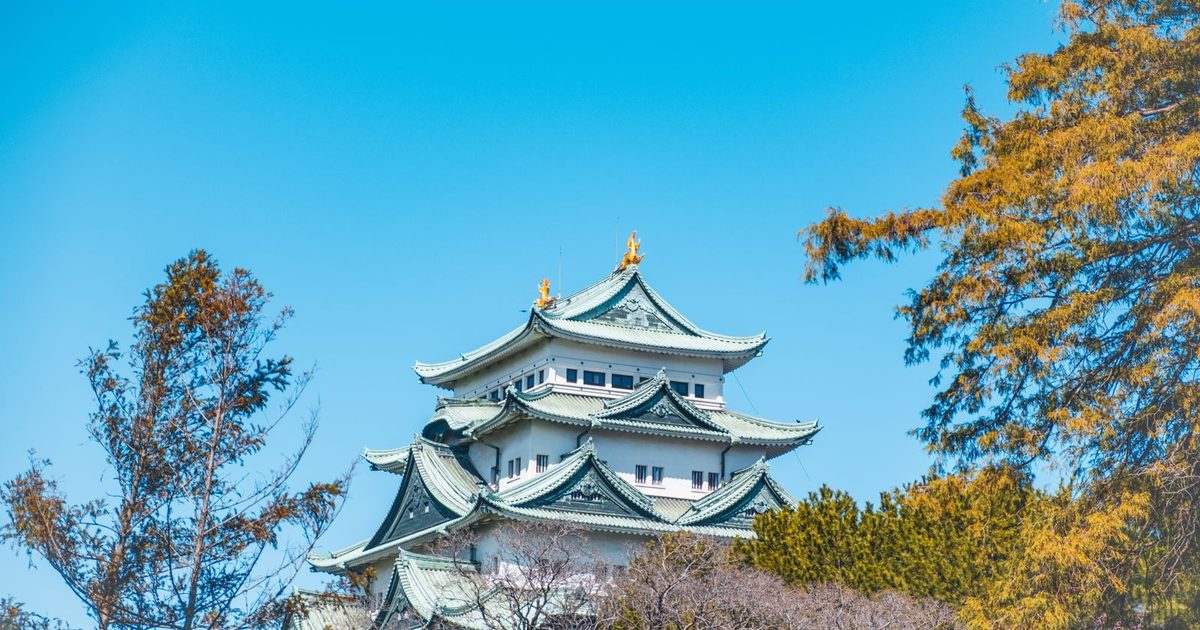
Nagoya weather by month
Averages for 1991–2020 at the Nagoya (名古屋) weather station, copied from our Aichi page, next to each month's share of Aichi's guest nights (Japan Tourism Agency, 2025). These are long-term averages, not a forecast.
| Month | Average high | Average low | Rain | Rainy days | Daylight on the 15th | Share of 2025 |
|---|---|---|---|---|---|---|
| January | 9.3 °C | 1.1 °C | 51 mm | 5.2 days | 10 h 5 min | 7.6% |
| February | 10.5 °C | 1.4 °C | 65 mm | 6.2 days | 10 h 55 min | 7.1% |
| March | 14.5 °C | 4.6 °C | 116 mm | 8.8 days | 11 h 55 min | 8.3% |
| April | 20.1 °C | 9.7 °C | 128 mm | 9.4 days | 13 h 5 min | 8.5% |
| May | 24.6 °C | 14.9 °C | 150 mm | 9.7 days | 14 h | 8.5% |
| June | 27.6 °C | 19.4 °C | 186 mm | 11.6 days | 14 h 30 min | 7.4% |
| July | 31.4 °C | 23.5 °C | 211 mm | 12.0 days | 14 h 20 min | 8.3% |
| August | 33.2 °C | 24.7 °C | 140 mm | 8.5 days | 13 h 30 min | 9.6% |
| September | 29.1 °C | 21.0 °C | 232 mm | 10.5 days | 12 h 25 min | 8.3% |
| October | 23.3 °C | 14.8 °C | 165 mm | 9.0 days | 11 h 20 min | 8.8% |
| November | 17.3 °C | 8.6 °C | 79 mm | 6.1 days | 10 h 20 min | 8.9% |
| December | 11.7 °C | 3.4 °C | 57 mm | 6.2 days | 9 h 50 min | 8.7% |
Golden hour
Evening golden hour is our calculation for the 15th of each month of 2026: the time the sun takes to go from 6° above to 4° below the horizon (there is no official definition).
The quietest and busiest months
In 2025, February was Aichi's quietest month (7.1% of the year's guest nights): average high 10.5 °C, average low 1.4 °C, 65 mm of rain. August was the busiest (9.6%): average high 33.2 °C, average low 24.7 °C, 140 mm of rain. The figures do not show that the weather makes a month busier or quieter, so we do not say it does.
What these figures are
One weather station stands for Nagoya; places nearby can differ, especially by height or distance from the sea. For the full picture of Aichi, including regions and holidays, see our Aichi page; for other places, the visual guides and golden hour by place.
Key takeaways
- Warmest month: August (average high 33.2 °C); coldest: January (average low 1.1 °C).
- Wettest month: September (232 mm); driest: January (51 mm).
- In 2025, February was Aichi's quietest month for visitors and August the busiest.
Sources
Weather normals and daylight copied from our country or prefecture page; tourism shares from the same page. See how we research.
- Weather: 出典:気象庁ホームページ(名古屋 平年値). Japan Meteorological Agency, 1991–2020 normals for the Nagoya station: daily maximum and minimum temperature, precipitation, days with at least 1.0 mm of precipitation (降水量の階級日数) and hours of sunshine (日照時間). Accessed 22 September 2026. Licensed under PDL1.0. 気象庁「平年値」を加工して作成 — edited by Gallivanting Gadabout (English wording, selection and rounding).
- Daylight: our calculation of the time from sunrise to sunset on the 15th of each month of 2026 at the weather station's location, by the method of the NOAA Solar Calculator (NOAA Global Monitoring Laboratory, “Solar Calculation Details”, based on Jean Meeus, Astronomical Algorithms, allowing 0.833° for refraction and the size of the sun). Read it. Checked 22 September 2026. NOAA notes that calculated times can differ from what is observed.
- Source: 「宿泊旅行統計調査」(観光庁) (Overnight Travel Statistics Survey, Japan Tourism Agency), 2025 annual figures (final), tables 2 and 8 and reference table 1, published 6 July 2026. Survey page · workbook. Accessed 17 September 2026. Licensed under the Public Data License 1.0 (PDL1.0).
Modified data: the arrangement, the golden-hour and sea columns and the quietest/busiest comparison are ours, from the cited figures.