At Abashiri, the Japan Meteorological Agency's 1991–2020 average date for the first drift ice is 22 January, the ice reaches the shore around 4 February, and the last ice is seen around 6 April. JMA ended these visual observations after the 2024/25 season, so these are the last official averages.
When does drift ice reach Hokkaido?
At Abashiri, the Japan Meteorological Agency's 1991–2020 average date for the first drift ice is 22 January, and the ice reaches the shore on average on 4 February. The last drift ice was seen on average on 6 April.1 JMA counts a first-ice date between 19 and 27 January as normal for Abashiri. The earliest first ice on record there was on 27 December 2001, and the latest on 15 February 2025.14
| Station | First drift ice | Normal range for the first ice | Ice reaches the shore | Last drift ice | Observations |
|---|---|---|---|---|---|
| Wakkanai 稚内 | 19 February (15) | 12 February to 25 February | Too few years (2) | 4 March (15) | Last-ice observations ended in 2021; first-ice and shore observations ended after the 2024/25 season |
| Kitami-Esashi 北見枝幸 | 24 January (14) | 19 January to 29 January | 4 February (13) | 28 March (14) | Ended in 2004 |
| Ōmu 雄武 | 25 January (14) | 21 January to 29 January | 5 February (12) | 28 March (14) | Ended in 2004 |
| Monbetsu 紋別 | 24 January (17) | 20 January to 27 January | 9 February (17) | 30 March (17) | Ended in 2007 |
| Abashiri 網走 | 22 January (30) | 19 January to 27 January | 4 February (30) | 6 April (30) | Last-ice observations ended in 2021; first-ice and shore observations ended after the 2024/25 season |
| Nemuro 根室 | 11 February (16) | 8 February to 14 February | 19 February (14) | 29 March (16) | Ended in 2010 |
| Kushiro 釧路 | Too few years (6) | Too few years | Not seen | Too few years (6) | Last-ice observations ended in 2021; first-ice and shore observations ended after the 2024/25 season |
The averages use only the years in which the ice was seen, and the number in brackets is how many years that was. “Too few years” means fewer than eight; “Not observed here” means the station did not record that item.1 In JMA's sea-ice statistics a year runs from December of the year before to May.4
What do the dates mean?
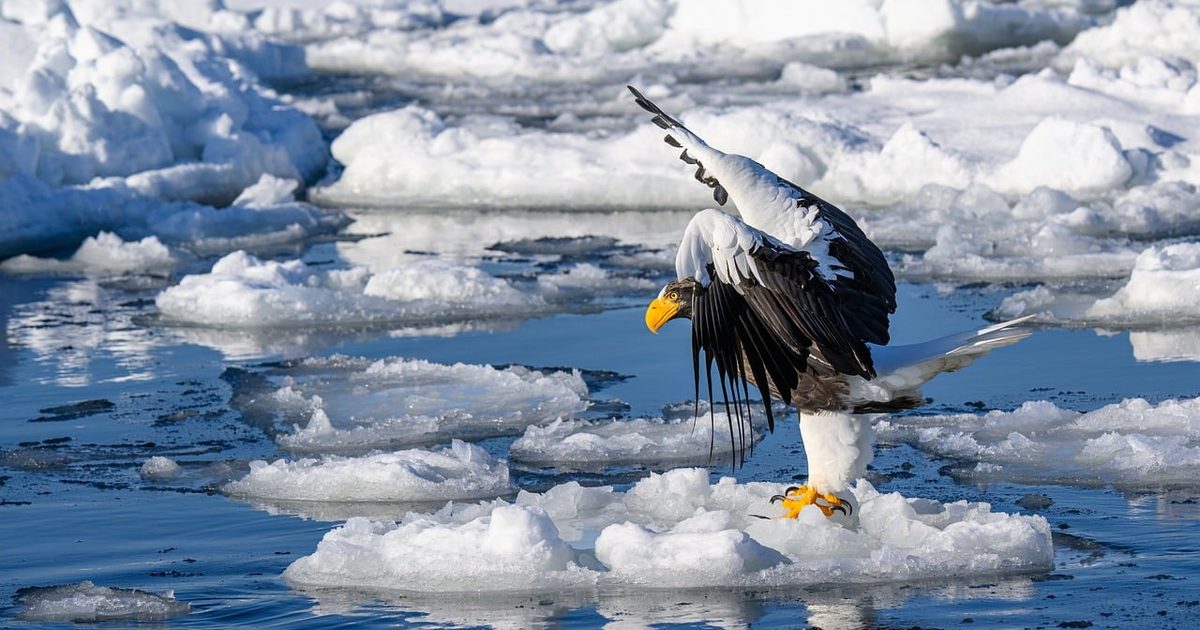
- Drift ice is sea ice that floats on the sea and is not fixed to the coast.2
- First drift ice is the first day drift ice that has come from beyond the observer's view is seen on the sea in view.2
- Ice reaches the shore is the first day the ice reaches the coast, or joins ice fixed to it, so that there is no channel left along the coast and ships cannot sail.2
- Last drift ice is the last day drift ice is seen on the sea in view.2
Why are there no dates after 2025?
JMA staff at the Wakkanai, Abashiri and Kushiro offices watched for the first drift ice and for the ice reaching the shore by eye. From the winter of 2025/26, JMA ended these visual observations and said it would instead promote area-wide information on its website.3 So the averages on this page are the last official ones, and no first-ice date will be announced for 2026 or later in the same way.
Key takeaways
- Abashiri averages: first drift ice 22 January, ice at the shore 4 February, last ice 6 April.
- These are averages; a first-ice date anywhere in JMA's normal range counts as normal.
- What we would skip: treating an average date as a forecast; in 2025 the first ice at Abashiri came later than on any year on record.
Sources
Dates parsed from JMA's own data files; definitions translated from JMA's terms page. See how we research.
- Normals: Japan Meteorological Agency, 北海道の海氷 平年値 (sea ice normals for Hokkaido, 1991–2020, with the normal range and the earliest and latest on record), page updated 9 December 2025, and the data files it loads. Read it. Accessed 6 October 2026. 出典:気象庁ホームページ(https://www.data.jma.go.jp/kaiyou/db/seaice/hokkaido/hokkaido_normal.html)を加工して作成。PDL1.0.
- Definitions: Japan Meteorological Agency, 予報用語 海氷 (forecast terms: sea ice). Read it. Accessed 6 October 2026. 出典:気象庁ホームページ(https://www.jma.go.jp/jma/kishou/know/yougo_hp/kaihyou.html)を加工して作成。PDL1.0.
- End of observations: Japan Meteorological Agency, press release, 9 December 2025. Read it. Accessed 6 October 2026. 出典:気象庁ホームページ(https://www.jma.go.jp/jma/press/2512/09e/20251209_seaice.html)を加工して作成。PDL1.0.
- Statistics notes: Japan Meteorological Agency, 北海道の海氷 統計 (Hokkaido sea ice statistics), page updated 9 December 2025. Read it. Accessed 6 October 2026. 出典:気象庁ホームページ(https://www.data.jma.go.jp/kaiyou/db/seaice/hokkaido/hokkaido_static.html)を加工して作成。PDL1.0.
Modified data: we translated JMA's Japanese pages, wrote the dates out in English and chose the columns. 出典:気象庁ホームページ(https://www.data.jma.go.jp/kaiyou/db/seaice/hokkaido/hokkaido_normal.html)を加工して作成。